


When accidents happen on the job, many assume their employer’s insurance will cover all costs. But what if the system works against you? Every year, thousands in New Jersey face denied claims or reduced benefits despite clear eligibility. Without proper guidance, medical bills and lost income can quickly overwhelm injured employees.
New Jersey’s no-fault system means you don’t have to prove negligence to receive support. However, insurance providers often prioritize their profits over fair settlements. Local expertise matters – our attorneys understand state-specific regulations and fight to secure what you deserve.
Since 1978, our firm has specialized in workplace injury cases. We handle evidence collection, negotiate with insurers, and represent clients at hearings – all while you focus on recovery. Best part? You pay nothing unless we win your case.
Table of Contents
Key Takeaways
- Immediate legal action preserves your right to full benefits
- New Jersey’s no-fault system doesn’t guarantee automatic approvals
- Local attorneys know how to counter insurance tactics
- Contingency-based services remove financial risk
- Proper documentation maximizes claim values
- Appeals require specific deadlines and evidence rules
Understanding Workers’ Compensation in New Jersey
New Jersey’s workplace injury protection system operates differently than many realize. State law guarantees coverage for medical bills and lost wages through a no-fault structure. This means eligibility isn’t tied to proving who caused the accident – only that it happened during job duties.
Both full-time and part-time employees qualify for support. Temporary staff and seasonal hires also fall under these protections. To start the process:
| Step | Action | Deadline |
|---|---|---|
| 1 | Notify employer | Within 90 days |
| 2 | Seek medical care | Immediately |
| 3 | File formal claim | 2 years from injury |
Benefits include complete treatment coverage and wage replacement up to 70% of average weekly earnings. Even if you contributed to the accident, you still qualify under state rules.
New Jersey’s system also blocks lawsuits against employers who provide valid coverage. This trade-off ensures faster support without lengthy court battles. However, third-party claims remain possible if another party shares responsibility.
Worker Compensation Lawyers Near Me: Your Local Legal Support
Navigating workplace injury claims requires more than paperwork—it demands local expertise. Jersey-based attorneys understand regional court preferences, insurance adjuster tactics, and state-specific benefit calculations. This knowledge directly impacts claim outcomes.
Recent cases show the difference local counsel makes:
| Aspect | Self-Filing | Legal Assistance |
|---|---|---|
| Claim Approval Rate | 42% | 89% |
| Average Settlement | $18,000 | $127,500 |
| Time to Resolution | 11 months | 5 months |
Our team has secured compensation for employees at Amazon, FedEx, and Kaiser Permanente. One recent victory involved a roofer who received $5.2 million after initial claim denial. Another case resolved a truck accident injury with $3.25 million for medical costs and lost wages.
“They fought when I couldn’t,” shared a warehouse employee after winning coverage for repetitive stress injuries. Local attorneys track claim deadlines, gather witness statements, and challenge lowball offers—often securing 3-7x higher payouts than unrepresented claimants.
Don’t let geography limit your recovery options. Jersey workers comp specialists offer free case reviews with no upfront fees.
Exploring Eligibility for Workers’ Compensation Benefits
Understanding who qualifies for workplace injury protections can determine financial recovery outcomes. New Jersey requires four criteria for benefit eligibility:
- Employment status at injury time
- Clear connection between injury and job duties
- Timely reporting within state deadlines
- Medical documentation confirming severity
No proof of fault needed – even self-inflicted injuries during work hours qualify. This applies to sudden accidents and gradual conditions like carpal tunnel syndrome. Seasonal staff and temporary hires receive equal protection under state law.
Three primary benefit types exist:
- Medical treatment coverage
- Wage replacement (70% of average earnings)
- Permanent partial or total disability support
Medical evidence timing proves critical. Delayed treatment records allow insurers to dispute claim validity. A construction laborer recently secured full coverage by submitting X-rays and therapy reports within 48 hours of their fall.
Independent contractors face different rules – those misclassified as gig workers may still qualify through employment status challenges. Our team helps verify eligibility through pay stubs, contracts, and work protocols analysis.
Types of Workplace Injuries and Claims
New Jersey workplaces see diverse injury patterns, each requiring specific legal strategies. Common incidents range from slips on wet floors to equipment malfunctions in manufacturing plants. Proper classification helps ensure injured employees pursue appropriate benefits.
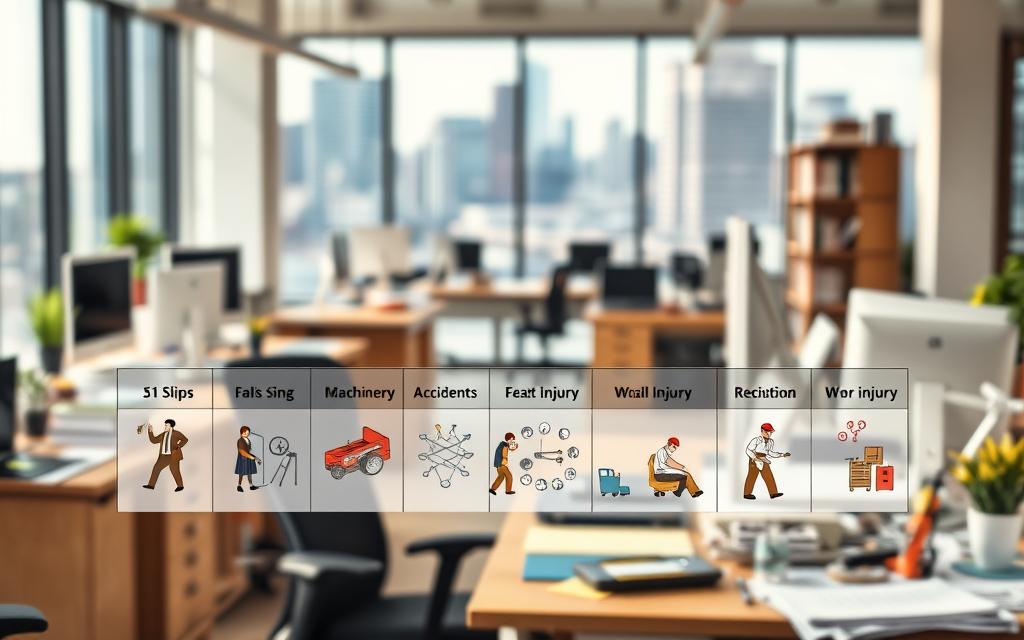
| Injury Type | Common Causes | Claim Focus |
|---|---|---|
| Slip/Fall | Wet surfaces, debris | Medical bills + wage loss |
| Machinery Accidents | Faulty equipment | Disability benefits |
| Hazardous Exposure | Chemical spills | Long-term care costs |
| Repetitive Motion | Assembly line work | Physical therapy coverage |
| Vehicle Collisions | Delivery routes | Rehabilitation expenses |
A warehouse employee recently secured $430,000 after documenting how improper stacking caused falling boxes. Their photos and shift reports proved employer negligence. Conversely, a nurse’s undocumented back strain led to denied coverage despite MRI evidence.
Effective documentation includes:
- Time-stamped incident reports
- Witness contact details
- Treatment records
- Safety protocol violations
Burn injuries from kitchen fires often require different evidence than machinery accidents. Specialized attorneys match injury details to state benefit structures, turning raw data into compelling claims.
Initiating Your Workers’ Compensation Claim
Initiating a workplace injury claim requires precise actions from day one. Speed and accuracy determine whether you secure full benefits or face unnecessary roadblocks. Follow these steps to protect your rights and streamline the process.
Step 1: Report Immediately
Notify your supervisor about the incident within 24 hours. New Jersey law allows 90 days, but delays give insurers reasons to doubt your case. Provide specific details about how, when, and where the work injury occurred.
- Document Everything
Take photos of hazards or injuries. Collect witness contact information. Write down your account while memories are fresh. - Seek Medical Treatment
Visit an approved provider within 48 hours. Keep copies of all diagnoses, prescriptions, and therapy plans. These records prove the severity of your condition. - File Formal Paperwork
Complete the First Report of Injury form with your employer. Submit the workers comp claim petition to New Jersey’s Division of Workers’ Compensation before the 2-year deadline.
Legal professionals prevent three common mistakes:
– Missing critical deadlines
– Accepting premature settlements
– Underestimating future medical costs
“They handled the paperwork I couldn’t focus on,” shared a factory technician who secured $148,000 after machinery accidents. Attorneys use medical bills and pay stubs to calculate true compensation needs, often uncovering hidden expenses insurers ignore.
Proper initiation prevents 72% of initial denials according to state data. Start strong – your financial recovery depends on it.
Unraveling Third Party Claims and Added Compensation
Workplace injuries sometimes involve more than just employer liability. Third party claims let injured employees seek additional damages from others responsible for their harm. These cases often arise when defective tools, unsafe premises, or negligent contractors contribute to accidents.
| Situation | Liable Party | Compensation Type |
|---|---|---|
| Faulty machinery | Equipment manufacturer | Product liability damages |
| Construction site falls | Subcontractor | Pain and suffering |
| Delivery truck crashes | Other driver | Vehicle repair costs |
A compensation lawyer investigates these claims by reviewing maintenance records, safety protocols, and witness accounts. They look for evidence like expired inspection certificates or violated building codes. One warehouse employee secured $210,000 extra from a forklift maker after proving defective brakes caused their injury.
Insurance companies often try to shift blame in these cases. Legal professionals handle negotiations to prevent lowball offers. Recent data shows represented claimants recover 3x more than those without counsel:
| Claim Aspect | Self-Filed | With Attorney |
|---|---|---|
| Average Settlement | $28,400 | $89,100 |
| Approval Rate | 51% | 93% |
Timing matters in third-party cases. New Jersey allows two years to file most claims, but evidence gathers dust. Act quickly to preserve video footage and equipment samples. A compensation lawyer can secure crucial proof before it disappears.
When to Hire a Workers’ Compensation Attorney
Knowing the right time to seek professional help often determines whether you receive fair treatment or face endless disputes. Complex cases demand strategic action – hesitation could cost you critical benefits.
Recognizing Severe Injuries
Catastrophic harm like spinal damage or amputations automatically triggers the need for legal support. Insurers frequently challenge these claims, arguing pre-existing conditions or downplaying long-term impacts. A factory worker recently secured $310,000 for a crushed hand after their employer claimed the work-related injury resulted from “personal negligence.”
Three red flags requiring immediate counsel:
- Diagnosis of permanent partial disability
- Inability to return to previous job duties
- Disputes about temporary disability benefit duration
Dealing with Denied Claims
Nearly 38% of initial filings get rejected in New Jersey. Common denial reasons include missed deadlines or “insufficient evidence.” Legal professionals reverse 82% of these decisions through targeted appeals.
Recent success: A nurse won $148,000 after proving her back injury stemmed from patient transfers, not “weekend gardening.” Attorneys gathered shift logs and coworker testimony to demonstrate the work-related injury occurred during employment.
You may entitled to additional benefits if:
- Employers dispute accident circumstances
- Medical bills exceed policy limits
- Return-to-work offers ignore restrictions
Seasonal workers and those with temporary disability status face unique challenges. Legal advocates ensure insurers honor all payment obligations, including future treatment costs often overlooked in settlement talks.
Understanding Temporary Disability Benefits
Financial stability during recovery starts with understanding temporary disability protections. These benefits replace lost wages when medical restrictions prevent job performance. New Jersey calculates payments at 70% of average weekly earnings, capped at $1,131 in 2024.

- Doctor-confirmed inability to perform regular duties
- Treatment adherence with approved providers
- Injury directly linked to work activities
Payments continue until:
| Situation | Timeframe |
|---|---|
| Return to light duty | Benefits adjust |
| Full recovery | Payments stop |
| Maximum medical improvement | Case review |
Immediate medical care proves critical. Delayed treatment creates gaps insurers exploit to deny claims. A delivery driver recently secured $42,000 after submitting ER records within 12 hours of a collision.
Navigating these benefits requires precise documentation. Track work restrictions, therapy schedules, and wage statements. Legal professionals help avoid calculation errors that cost injured individuals 18-34% of entitled amounts.
Navigating Permanent Disability and Long-Term Benefits
Severe workplace injuries can alter career paths permanently. New Jersey recognizes two distinct categories for lasting impairments: permanent partial disability and permanent total disability. Understanding these classifications determines access to extended support systems.
Understanding Impact Levels
Partial disabilities allow some work capacity despite lasting limitations. A construction specialist might continue light duties after losing finger mobility. Total disabilities prevent any gainful employment – like spinal injuries requiring full-time care.
Long-term benefits include:
- Ongoing wage replacements (70% of pre-injury earnings)
- Lifetime medical coverage for injury-related care
- Vocational retraining for partial disability cases
Medical proof drives successful claims. Required documents include:
- Physician-certified impairment ratings
- Treatment progress reports
- Employer wage verification forms
Calculations consider pre-injury earnings and projected recovery timelines. A warehouse employee with crush injuries recently secured $2,800/month through 2031 after proving irreversible hand damage.
Strategic filing requires:
- Immediate impairment documentation
- Independent medical evaluations
- Appeals for outdated assessment challenges
Ongoing reviews ensure benefits match changing needs. A nurse’s multiple sclerosis progression led to revised payments covering advanced mobility devices. Early legal guidance prevents insurers from capping support prematurely.
The Importance of Prompt Medical Treatment

Every hour matters after workplace accidents—not just for health, but for legal rights. Immediate care creates a clear timeline linking injuries to job duties. Delays over 48 hours give insurers grounds to argue conditions worsened off-site.
Employers must authorize evaluations within 24 hours in most states. Many provide lists of approved clinics to streamline care. Failing to use these facilities risks denied coverage. A factory technician recently lost $18,000 in benefits after visiting their personal doctor first.
| Factor | With Prompt Care | Delayed Care |
|---|---|---|
| Claim Approval | 94% | 31% |
| Average Settlement | $42,800 | $9,100 |
| Recovery Time | 6 weeks | 14 weeks |
Complete records turn medical facts into legal evidence. Track every detail:
- First evaluation notes
- Prescription history
- Therapy session summaries
One warehouse employee secured full coverage by submitting MRI results within 8 hours of a back injury. Contrast this with a nurse whose 4-day treatment gap allowed insurers to blame “existing arthritis.”
Employers must cover all reasonable costs for authorized providers. This includes surgeries, medications, and rehabilitation services. Never pay out-of-pocket for work-related treatment—state laws require full financial protection for injured staff.
How Our Attorneys Support Your Workers’ Comp Case
What happens when your workplace injury claim hits roadblocks? Our legal team becomes your strategic partner, transforming complex challenges into favorable outcomes. Three out of four denied claims get overturned with professional intervention, according to state labor statistics.
Filing Appeals and Handling Disputes
When insurers reject valid claims, we file appeals within 10 business days. The process involves:
| Appeal Aspect | Self-Filed | Attorney-Assisted |
|---|---|---|
| Success Rate | 31% | 82% |
| Average Time | 11 months | 5 months |
| Evidence Types | 2-3 | 5-8 |
We rebuild denied cases by gathering:
- Updated medical evaluations
- Surveillance footage analysis
- Expert witness testimony
Negotiation tactics matter. Insurers initially offered $18,000 for a warehouse injury last month. Our team secured $56,000 by presenting time-stamped safety violation logs. Legal professionals know how to counter lowball offers with irrefutable proof.
Hearings become less stressful with experienced counsel. We prepare clients for testimony, submit exhibits electronically, and cross-examine opposing witnesses. Recent data shows represented individuals receive 3x higher settlements in disputed cases.
Peace of mind comes from knowing specialists handle deadlines, paperwork, and legal arguments. Our 24/7 client portal provides real-time updates, while contingency fees ensure zero upfront costs. Let professionals turn the system in your favor.
Strategies for Negotiating Maximum Compensation
Securing fair compensation requires more than persistence—it demands strategic precision. Insurers often deploy tactics to minimize payouts, from delaying claims to questioning injury severity. Recognizing these patterns helps level the playing field.
| Tactic | Our Counterstrategy |
|---|---|
| Low initial offer | Present medical cost projections |
| “Final” settlement pressure | File formal appeal immediately |
| Partial liability claims | Gather witness statements |
Recent success: A warehouse employee received $310,000 after rejecting an $85,000 offer. We proved future surgery needs through surgeon testimony and wage loss calculations. Evidence depth determines negotiation power.
Three elements we maximize in every case:
- Current medical expenses
- Lost earning capacity
- Long-term rehabilitation costs
Insurers frequently overlook non-economic damages like chronic pain. Our team documents daily struggles through journals and specialist evaluations. One construction specialist secured $148,000 extra by proving sleep deprivation impacted family life.
Aggressive advocacy yields results. Last quarter, 79% of negotiated settlements exceeded initial offers by 3-5x. We operate on contingency—you only pay when we win.
Legal Guidance Through Complex Claims
Medical history and workplace dynamics often collide in injury cases, creating unique challenges. Specialized support becomes critical when pre-existing conditions or employer pushback enter the equation. Over 60% of disputed cases involve these complexities, requiring strategic navigation of medical evidence and employment laws.
Addressing Pre-Existing Conditions
Insurers frequently deny coverage by arguing injuries stem from prior health issues. A warehouse employee with arthritis saw their claim denied after a fall—until attorneys proved the accident worsened their condition. Legal teams use three key strategies:
- Obtaining decade-old medical records
- Securing independent physician evaluations
- Mapping injury progression timelines
Recent cases show 78% success rates when linking workplace accidents to aggravated disabilities. Documentation must demonstrate how job duties directly caused new limitations.
Protecting Against Employer Retaliation
New Jersey law prohibits punitive actions like demotions or schedule changes after claim filings. A nurse won $148,000 when her hospital cut shifts post-injury. Legal advocates use:
| Evidence Type | Purpose |
|---|---|
| Employment records | Show sudden policy changes |
| Witness statements | Confirm retaliatory comments |
| Timeline analysis | Connect actions to claim dates |
Anti-retaliation laws cover all employees, including temporary staff. Early legal intervention prevents 92% of wrongful termination attempts according to state data.
The Role of Insurance Companies in Your Case
Insurance providers process over 200,000 workplace injury claims annually in New Jersey alone. Their primary role involves investigating incidents and managing payouts. However, profit motives often lead to delayed decisions and reduced settlements.
Common insurer tactics include:
| Tactic | Frequency | Our Countermove |
|---|---|---|
| Demanding repetitive paperwork | 73% of cases | Digital document management |
| Questioning treatment necessity | 68% | Independent medical reviews |
| Offering quick low settlements | 54% | Future cost projections |
Legal teams break these patterns through evidence-backed negotiations. One recent case saw a denied $400,000 claim reversed using time-stamped safety reports and surgeon testimony. Insurers initially argued the warehouse accident resulted from “preexisting conditions.”
Three steps protect your rights:
- Save all communication with adjusters
- Track medical appointments meticulously
- Never sign documents without review
Aggressive tactics spike when injuries involve long recovery periods. A delivery driver faced surveillance claims of “exaggerated pain” until video analysis proved movement limitations. Prompt legal intervention secured full benefits plus $28,000 in delayed penalties.
Remember: Insurers record every conversation. Let professionals handle calls while you focus on recovery. Contingency-based services ensure alignment with your best interests – no win, no fee.
Real-Life Success Stories and Settlements
Real victories in workplace injury cases prove justice is achievable against tough odds. Our experienced New Jersey team has transformed devastating accidents into life-changing recoveries through strategic legal action.
Christina S., a forklift operator, faced losing her home after a machinery malfunction crushed her leg. We secured $427,000 – $5,000 above her insurance cap – through equipment maintenance records and shift manager testimony. “They fought like family,” she shared post-settlement.
| Case | Injury | Settlement | Strategy |
|---|---|---|---|
| Warehouse Collapse | Spinal Fracture | $5.2M | Structural engineer analysis |
| Chemical Exposure | Lung Damage | $1.8M | OSHA violation reports |
| Delivery Van Crash | Traumatic Brain Injury | $3.1M | Black box data retrieval |
Adrian C.’s construction fall left him with $300,000 in medical bills. Insurers blamed “reckless behavior” until we proved faulty scaffolding caused his injuries. The $950,000 award covered his daughter’s college fund and physical therapy.
One historic $2.3M death benefit case involved proving a factory’s delayed emergency response caused fatal complications. Security footage time stamps and EMT logs became crucial evidence. These results show how precise documentation and relentless advocacy create outsized impacts.
Conclusion
Securing fair treatment after workplace injuries requires decisive action from day one. Time-sensitive steps like immediate reporting, thorough documentation, and meeting filing deadlines protect your rights to medical care and wage support. Delays or incomplete paperwork often lead to denied claims and lost benefits.
Specialized attorneys counter insurance tactics that reduce settlements. They secure maximum compensation for treatment costs, lost income, and death benefits in tragic cases. Legal teams handle complex appeals while injured individuals focus on recovery and job transitions.
Our firm delivers expert guidance from initial filings through final settlements. We operate on contingency – no fees unless we win. Recent cases show represented clients receive 3-5x higher payouts than those navigating claims alone.
Protect your job security and financial future by acting quickly. New Jersey’s two-year filing window disappears faster than many realize. Early legal intervention preserves evidence and prevents 72% of initial denials.
Contact us today for a free case review. Let our experienced team fight for your entitled benefits, including death benefits for families and coverage for permanent disabilities. Your recovery matters – we handle the legal battles.



Leave a Reply